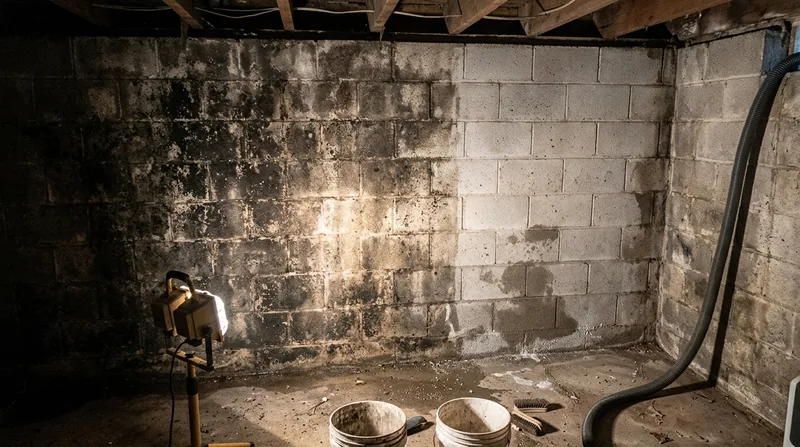




South Bend sits on lake-plain clay and glacial till that holds spring water and drains slowly, so the water table climbs through March and April and pushes moisture through poured concrete, block and old fieldstone basement walls. That constant damp is what feeds basement mold, especially in the 1900s-1930s bungalows and foursquares of the Northeast Neighborhood, Sunnymede and Kern Park, and in the partly finished basements of Francis Park and Rum Village. Basement Mold Remediation in South Bend means removing the mold and fixing the moisture source, not just wiping walls. We start with a musty smell diagnostic, find where water is entering, then contain, treat and remediate affected surfaces. If you are still at the wet basement stage, start with our basement waterproofing service before mold takes hold.
Why Basement Mold Grows So Fast in South Bend Homes
The dominant failure mode here is groundwater wicking through hairline cracks and porous block after the spring thaw, then staying trapped behind drywall and paneling. Freeze-thaw cycles open those cracks wider each winter, and fast summer thunderstorm runoff pushes water toward low corners and footing drains that may be clogged or past their life. Old fieldstone walls in the Studebaker-era cottages weep constantly, while 1990s-2020s Granger and Osceola subdivisions see condensation on cold poured walls.
- Spring water table rise saturates the soil and drives hydrostatic pressure against basement walls.
- Clogged or collapsed drain tile lets water pool at the footing instead of draining away.
- Failed sump pumps during a storm leave several inches of water standing on the slab.
- Poor grading and short downspouts dump roof water right against the foundation.
- Missing vapor barriers let ground moisture migrate up through the slab and walls.
Each of these keeps basement materials damp long enough for mold to colonize, which is why we fix the moisture path before we treat the mold.
Key info: A 1920s foursquare in Sunnymede with efflorescence on the block walls and a musty smell every April usually has water entering at the cove joint, not a mold problem that started on its own. We see the same pattern in Mishawaka ranches and Granger walkouts.
For official guidance on moisture and mold in buildings, see the EPA mold resources.
How We Run a Basement Mold Remediation in South Bend
We treat mold as a moisture and building-materials problem, so the job starts with finding the water, not with spraying bleach. Our process follows a fixed sequence that keeps spores contained and makes sure the mold does not return the next time the water table climbs. Every step is documented, and we stop to explain what we found before we move to the next phase.
- We inspect the basement, test for musty smell sources and map every damp spot, crack and stain.
- We set up containment with plastic sheeting and negative air pressure to keep spores out of the rest of the house.
- We remove and bag porous materials that cannot be cleaned, such as soggy drywall, insulation and wood.
- We treat affected surfaces with an antimicrobial and HEPA-vacuum the whole area.
- We fix the moisture source with crack injection, interior drain tile, a vapor barrier or a dehumidifier as needed.
- We verify dryness with a moisture meter and leave a written summary of what was done.
If the water is coming through the wall itself, we pair remediation with foundation crack repair so the same crack does not re-wet the wall.
Key info: In a Francis Park colonial with a partly finished basement, we pulled wet paneling, treated the block, then installed an interior perimeter drain and a new sump basin. The homeowner in Osceola with the same symptoms needed only epoxy injection on two cracks and a dehumidifier.
Remediation Approaches We Use in South Bend Basements
Not every mold job is the same, and the right approach depends on how wet the basement gets and what is growing on. The table below shows the methods we use most in South Bend and the situations each one fits.
| Approach | Description | Best for |
|---|---|---|
| Containment and HEPA remediation | Seal the work area, scrub surfaces, HEPA-vacuum and bag debris. | Surface mold on walls, joists and stored items. |
| Crack injection plus treatment | Epoxy or polyurethane injection closes the water path, then we treat the wall. | Mold clustered around a single seeping crack. |
| Interior drain tile and sump | Perimeter drain and sump basin relieve hydrostatic pressure at the cove joint. | Wet floors and recurring damp after spring rain. |
| Vapor barrier and dehumidification | Seal the slab and walls, control humidity with a dehumidifier. | Condensation on cold poured walls in newer homes. |
We pick the lightest approach that actually solves the moisture problem, and we tell you when simple crack sealing is enough.
Basement Mold Remediation Cost in South Bend: What to Expect
Most basement mold remediation jobs in South Bend start from $1,500, and that figure covers containment, surface treatment, HEPA vacuuming and disposal of affected materials in a typical single-room basement. The price moves with square footage affected, how much porous material has to come out, and whether the moisture fix is included. A small patch around one crack is at the low end; a full finished basement with wet drywall and a failed sump pump lands well above it.
Getting two or three estimates is smart because the scope can vary widely between contractors. Ask each one what moisture fix they include, since remediation without a drainage or waterproofing fix will not last through the next spring. Our full pricing overview breaks down the components so you can compare line by line.
Basement Mold Remediation Near Me: How to Vet a Contractor Near South Bend
When you search for basement mold remediation near me, the list of names can look the same, so check a few basics before you book. Ask for proof of licensing and insurance, and confirm the certificate is current. Get at least two or three written estimates with the moisture fix spelled out. Call references from jobs in South Bend, Mishawaka or Granger and ask whether the basement stayed dry the following spring.
Permits are commonly required for structural foundation repair and for work that alters drainage or the sanitary connection of a sump discharge, and thresholds vary by jurisdiction, so confirm with the local building department. If your home is in a historic district, check any exterior requirements before work starts. Ready to book? Contact us for a free estimate.
Where We Work
We handle basement mold remediation across South Bend and the surrounding communities, including Mishawaka, Granger and Osceola. The housing stock differs from one neighborhood to the next, and we adjust the moisture fix to match what we find.
Basement Mold Remediation in South Bend: Pricing Guide
| Service | Price | Details |
|---|---|---|
| Single-room surface remediation | Starting at $1,500 | Containment, surface treatment, HEPA vacuuming and disposal in one affected basement room. |
| Remediation plus crack injection | Starting at $2,200 | Adds epoxy or polyurethane injection on the seeping crack that fed the mold growth. |
| Remediation plus interior drain tile | Starting at $4,500 | Adds perimeter drain and sump basin where hydrostatic pressure keeps the floor wet. |
| Full finished basement remediation | On estimate | Wet drywall, insulation and framing removal plus moisture fix needs an on-site look first. |
| Travel | Included | In South Bend and surrounding areas, no separate call-out or mileage fee. |
| Estimate | Free | Response within 24h at (574) 800-3811, no obligation to book. |
Indicative pricing, the exact cost depends on square footage, finish, and site access. Free personalized estimate within 24h at (574) 800-3811.


