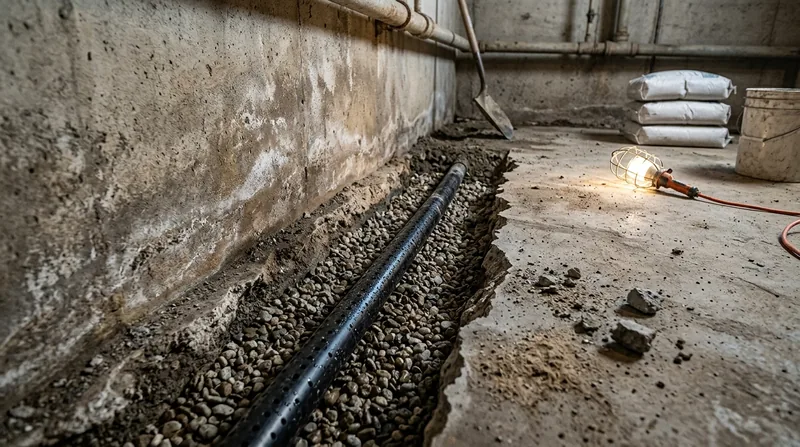




Interior Drain Tile System in South Bend: Stop the Water at the Footing
South Bend sits on a lake-plain of glacial clay and till that holds spring water like a sponge, and when the water table climbs through March and April, basements in the Northeast Neighborhood, Sunnymede and Kern Park tell the story first. If you have water pooling at the cove joint, efflorescence climbing the block, or a musty basement smell that returns every thaw, an Interior Drain Tile System in South Bend is usually the answer that actually works. We install interior perimeter drain tile beneath the slab edge, capture water at the footing, and channel it to a sump basin that pumps it out and away from the foundation. It works on poured concrete, block and old fieldstone walls, and because it is all below grade and inside, we can install it in any season, even in January. If you are still sorting out whether you need a full system or just a repair, start with a basement waterproofing assessment and we will tell you plainly.
Why Interior Drain Tile Matters in South Bend's Clay and Frost
Most of the residential ground here is heavy glacial clay that drains slowly, so spring melt and fast summer thunderstorm runoff push water sideways toward low corners and footing drains instead of soaking away. Winters bring deep frost and freeze-thaw cycles that open hairline wall cracks, and St. Joseph River flood stages add pressure during wet springs. In the Studebaker-era cottages of Rum Village and the 1920s brick colonials of Francis Park, original weeping tile is often crushed, clogged with roots or simply gone, which is why the water finds the slab edge.
- Hydrostatic pressure pushes water through the cove joint where the wall meets the footing, no matter how tight the wall looks.
- Block walls wick water into the cores and release it as efflorescence and white powder on the interior face.
- Old fieldstone and rubble foundations in the East Bank area leak at the mortar joints once the water table rises.
- Failed footing drains in 1950s ranches in Mishawaka and Granger back up and send water to the lowest slab corner.
An interior perimeter drain intercepts that water before it reaches the floor, which is why it outperforms surface patching in clay soil.
Key info: In the 1900s-1930s bungalows of Sunnymede, we routinely find the original clay weeping tile collapsed under the footing. The interior drain tile we install replaces that failed line at the footing, not at the wall face, so it catches water at the source.
Permits for work that alters drainage or the sanitary connection of a sump discharge vary by jurisdiction, so always confirm requirements with the City of South Bend building department before work begins.
How We Install an Interior Drain Tile System in South Bend
We start by walking the basement and the exterior grade, because the fix depends on where the water actually enters. In poured-wall 1990s subdivisions in Granger and Osceola, the leak is often the cove joint; in a 1940s Francis Park colonial, it is usually a combination of wall seepage and a dead footing drain. We map the slab, check the existing sump basin and discharge line, and then we cut and install.
- We break a 12 to 16 inch channel around the interior perimeter and remove the concrete cleanly.
- We dig down to the footing and lay perforated drain tile in washed gravel, with filter fabric to keep clay fines out.
- We core or set a sump basin at the low point and tie the perimeter line into it with a proper slope.
- We install a sump pump with a check valve and route the discharge line to daylight or a dry well, clear of the foundation.
- We backfill with gravel, pour new concrete over the channel, and leave the floor flush and usable.
Every system we install is tested with water before we close the slab, and we show you the pump cycling before we leave.
Local example: A split-level in Mishawaka near Lincolnway had water crossing the floor every March. The footing drain was silted solid. We installed 96 linear feet of interior perimeter drain tile tied to a new sump basin, and the floor has stayed dry through two spring thaws. For comparable work in that ZIP, see our Mishawaka 46545 page.
Interior Drain Tile Approaches We Use in South Bend Homes
The right configuration depends on wall type, slab condition and how the water behaves at the footing. Here is how the main approaches compare for South Bend housing stock.
| Approach | Description | Best for |
|---|---|---|
| Full interior perimeter drain | Continuous perforated tile around the entire footing, tied to a central sump basin. | Widespread seepage at the cove joint in clay soil. |
| Partial or targeted run | Drain tile along one or two wet walls only, often the low corner. | Isolated leaks on a single wall in a dry basement. |
| Drain tile plus wall sealing | Perimeter drain combined with crack injection or sealing on the wall face. | Block or fieldstone walls with visible cracks and seepage. |
| Drain tile plus sump upgrade | New perimeter drain tied to a modern sump basin and pump with check valve. | Old undersized sump pits in 1950s-1970s ranches. |
| Drain tile plus battery backup | System paired with a battery backup pump for storm-driven power outages. | Homes that lose power during summer thunderstorms. |
We size the system to the water volume we actually see, not to a template, and we tell you when a partial run is enough.
Interior Drain Tile System Cost in South Bend: What to Expect
Most interior drain tile work in South Bend starts around $50 per linear foot, and that figure typically covers the channel cut, gravel, perforated tile, filter fabric, concrete replacement and tie-in to an existing sump basin. A full perimeter on a typical 1,000 square foot basement lands in a predictable range, while a partial run on one wet wall costs less. The number moves with wall type, slab thickness, whether we are cutting a new sump basin, and how much old concrete has to come out.
- Footage of drain tile is the biggest driver, so a full perimeter costs more than a two-wall run.
- Fieldstone and rubble walls need more careful excavation and often parging, which adds labor.
- Adding a new sump basin, pump and discharge line is a separate line item from the drain itself.
- Finished basements require floor protection and careful cutting, which affects the schedule.
- Emergency calls during a spring flood may carry priority scheduling, but the scope still drives the price.
Get two or three written estimates and compare scope line by line, because a low number that skips the gravel and fabric is not the same job. Our full pricing overview breaks down the line items.
Choosing an Interior Drain Tile System Contractor Near Me in South Bend
Waterproofing is a below-grade trade, and the contractor you hire should be able to explain hydrostatic pressure, footing drains and sump discharge without hand-waving. Ask for proof of licensing and insurance, and confirm the certificate covers general liability and workers' compensation. Get at least three estimates, ask for references from South Bend jobs done at least two winters ago, and ask who pulls any required permit for drainage or sump discharge alterations.
Ask whether the crew is employees or subcontractors, what the warranty covers and whether it is transferable, and how they handle the discharge line so it does not freeze or dump water back against the foundation. A contractor who walks the exterior grade and checks downspout extensions before quoting is doing it right.
Key info: Call (574) 800-3811 to schedule a free basement inspection and a written estimate with no obligation.
Interior Drain Tile System Near Me: What South Bend Homeowners Should Know
If you are searching for an interior drain tile system near me in South Bend, the key question is whether your water problem is hydrostatic pressure at the footing or a simple wall crack. A crack that weeps after rain can often be closed with epoxy or polyurethane injection at a fraction of the cost, and we will tell you when that is the honest answer. When water crosses the floor, saturates the cove joint or returns every spring, the interior drain is the right call.
Interior work also beats exterior excavation for most South Bend homes, because digging up established landscaping and mature trees to reach the footing is disruptive and often unnecessary when the water can be intercepted from inside. We install in any season, so a January job in New Carlisle or a July job in Granger is equally practical. For a free assessment, call (574) 800-3811 or request a free basement inspection.
Interior Drain Tile System in South Bend: Pricing Guide
| Service | Price | Details |
|---|---|---|
| Full interior perimeter drain tile | Starting at $50/linear ft | Includes channel cut, gravel, perforated tile, filter fabric, concrete replacement and sump tie-in. |
| Partial or targeted drain run | Starting at $50/linear ft | One or two wet walls only, priced by footage with the same materials and finish. |
| Drain tile plus new sump basin and pump | On estimate | Adds basin, pump, check valve and discharge line; scope depends on existing pit condition. |
| Fieldstone or rubble wall prep | On estimate | Extra labor for careful excavation and parging on old fieldstone foundations. |
| Travel | Included | In South Bend and surrounding areas, no separate call-out or mileage fee. |
| Estimate | Free | Response within 24h at (574) 800-3811, no obligation to book. |
Indicative pricing, the exact cost depends on square footage, finish, and site access. Free personalized estimate within 24h at (574) 800-3811.


