



Foundation Crack Repair in South Bend: What Glacial Clay Does to Your Basement Walls
If you own a home in South Bend, your basement walls have been working against the ground since the day they were poured. Much of the city sits on lake-plain clay and glacial till that holds spring water and drains slowly, so the water table climbs through March and April and pushes against your foundation. That pressure finds every hairline crack, every cold joint, every spot where the block mortar has given up. Foundation Crack Repair in South Bend starts with reading the crack itself, because a vertical shrinkage crack in a 1920s Sunnymede bungalow is a different animal from a stair-step crack in a 1990s Granger walkout.
We inject non-structural cracks with epoxy or polyurethane, and we tell you straight when a crack is a symptom of something bigger. If you are seeing water on the floor and not just a damp line on the wall, start with our basement waterproofing service and we will sort out whether the crack is the cause or the messenger.
Why Crack Repair Matters More Here Than in Most Indiana Cities
South Bend winters bring deep frost, lake-effect snow and repeated freeze-thaw cycles. Water seeps into a hairline crack, freezes, expands and widens it a little more each winter. Add the clay soil swelling in spring and settling in dry August, and you get movement that opens cracks in poured walls and shears the mortar joints in older block and fieldstone foundations. The Northeast Neighborhood and East Bank have plenty of both.
- Freeze-thaw cycling widens existing hairline cracks every winter, especially on north-facing walls that stay frozen longer.
- Glacial clay holds water against the wall and drives hydrostatic pressure through the crack, not just dampness.
- Studebaker-era cottages in Francis Park and Rum Village often have block walls with deteriorated parging that hides the real crack line.
- Spring water table rise in March and April turns a slow seep into a steady trickle across the basement floor.
Ignoring a crack does not make it stable. It lets water in and lets the freeze-thaw cycle keep working on it.
Key info: A homeowner in Mishawaka called us about a damp spot under a basement window in a 1960s ranch. The crack was 1/16 inch wide and ran vertically from the window corner. Epoxy injection closed it in under two hours. The same call in April, with the water table up, would have needed a look at the footing drain too.
Structural foundation repair permits are commonly required in this area, and the rules vary by jurisdiction. Always confirm with the local building department before work begins. The City of South Bend publishes current permit guidance.
How We Diagnose and Repair a Foundation Crack in South Bend
We do not sell one patch for every crack. The first step is figuring out what the crack is telling us: shrinkage, settlement, hydrostatic pressure, or a bowing wall starting to move. That diagnosis decides whether you need injection, a structural repair, or drainage work behind the wall. We walk the basement, check the crack width and direction, look for efflorescence and rust stains, and probe the wall with a tap hammer to find hollow parging.
- We inspect the crack and the surrounding wall, inside and out where accessible, and note width, direction and moisture.
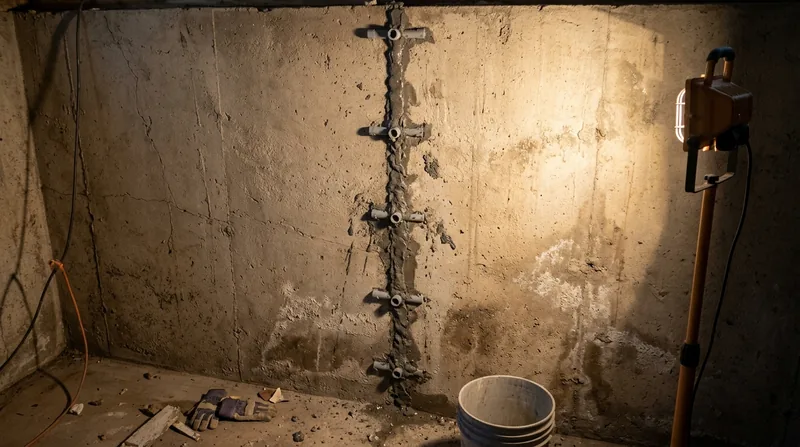
- We clean the crack and drill injection ports at the right spacing for the wall material and crack width.
- We inject epoxy for structural, non-moving cracks or polyurethane for cracks that may still move or are actively leaking.
- We seal the surface, remove the ports and check the repair before we leave.
- If the crack is wide, offset or paired with a bowing wall, we recommend carbon fiber straps or wall anchors instead of injection alone.
Every repair ends with a clear explanation of what we did and what to watch for next spring.
Key info: A 1930s foursquare in the East Bank had a stair-step crack in a block wall with white efflorescence across the lower courses. The crack was not the whole story. The footing drain was clogged, and water was sitting against the wall. We injected the crack and referred the drainage to our drain tile repair service so the repair would hold.
Crack Repair Methods We Use in South Bend Homes
Matching the method to the crack is the whole job. Here is how the main approaches compare for the wall types we see across South Bend, Mishawaka and Granger.
| Approach | Description | Best for |
|---|---|---|
| Epoxy injection | Structural adhesive injected into a cleaned crack to bond the concrete back together. | Non-moving vertical or diagonal cracks in poured walls |
| Polyurethane injection | Flexible resin that expands and seals active leaks in wet cracks. | Leaking cracks, cracks that may still move, block wall joints |
| Carbon fiber straps | Straps bonded to the wall to resist inward movement from soil pressure. | Bowing or displaced walls with horizontal cracks |
| Wall anchors | Anchors driven into stable soil outside to pull a moving wall back. | Walls that have moved inward and need realignment |
| Crack sealing with parging repair | Surface sealing and fresh parging over minor non-structural cracks. | Hairline surface cracks with no water entry |
If the crack comes with a wall that is visibly bowing, injection alone will not fix it. Our bowing wall repair service covers the structural side.
Foundation Crack Repair Cost in South Bend: What to Expect
Most single-crack injection jobs in this market start around $450, and that figure is real for a straightforward vertical crack in an accessible poured wall. What moves the number up is the wall type, the crack length and width, whether the crack is actively leaking, and how much prep the wall needs before injection. A block wall with deteriorated parging takes longer than a clean poured wall. A crack that turns out to be a symptom of hydrostatic pressure needs drainage work, and that is a different conversation.
We give you a range on the phone when we can and a firm number after the inspection. Getting two or three estimates is smart, and it is also smart to ask each contractor whether they are quoting injection alone or the drainage behind it. You can see where the main repair categories land on our pricing page.
Choosing a Foundation Crack Repair Contractor Near Me in South Bend
You are hiring a specialist, not a general handyman. Ask for proof of licensing and insurance, and do not settle for a verbal yes. Ask how they decide between epoxy and polyurethane, because a contractor who only has one method will sell you that method. Ask for references from jobs in your part of town, and check whether the repair was a crack injection or a drainage job. If your home is in a subdivision with an HOA, confirm any exterior work requirements before scheduling.
Call South Bend Waterproofing at (574) 800-3811 to set up an inspection.
Foundation Crack Repair in South Bend: Pricing Guide
| Service | Price | Details |
|---|---|---|
| Single crack epoxy injection | Starting at $450 | Includes crack cleaning, port drilling and epoxy injection for one non-moving poured-wall crack. |
| Polyurethane injection (active leak) | Starting at $550 | Includes flexible resin injection for a leaking crack, with prep and port work. |
| Multiple cracks or block wall | On estimate | Priced after inspection because crack count, wall material and parging condition vary. |
| Structural repair (bowing wall) | On estimate | Carbon fiber straps or wall anchors require an on-site structural assessment before pricing. |
| Travel | Included | In South Bend and surrounding areas, no separate call-out or mileage fee. |
| Estimate | Free | Response within 24h at (574) 800-3811, no obligation to book. |
Indicative pricing, the exact cost depends on square footage, finish, and site access. Free personalized estimate within 24h at (574) 800-3811.


