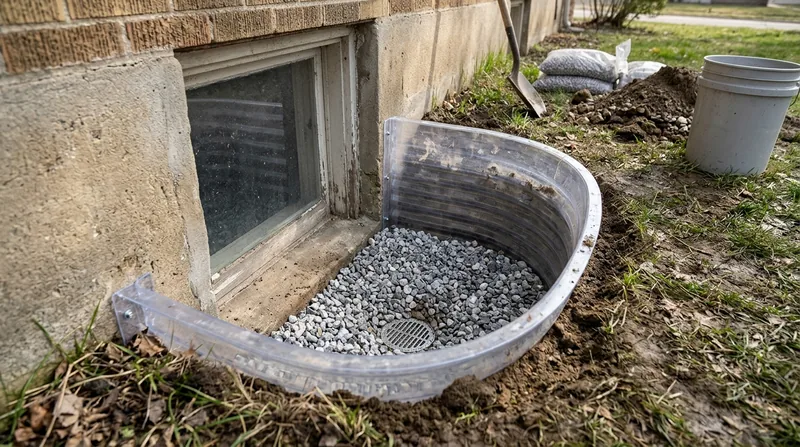




South Bend sits on a bed of lake-plain clay and glacial till that holds spring water and drains slowly, so when the water table climbs through March and April or a fast summer thunderstorm dumps runoff against the house, that water looks for the lowest point it can find. For a lot of homes in the Northeast Neighborhood, Sunnymede, Kern Park and East Bank, that low point is a window well cut into a 1920s brick or fieldstone foundation. Window Well Drainage & Repair in South Bend targets a leak source most homeowners never suspect and many inspectors miss, and it stops the well from filling with snowmelt and dumping water straight against the foundation. If you have already seen water on the floor near a below-grade window, start with a basement waterproofing assessment so we can trace the entry point before it spreads.
Why Window Wells Fail in South Bend's Clay and Frost
A window well is a shallow pit, and in South Bend's soil a pit is a bucket. Glacial clay does not absorb storm runoff, so water sheets across the yard, pours over the rim and pools against the window frame. Deep winter frost and repeated freeze-thaw cycles heave the corrugated metal ring, crack the mortar at the sill and open hairline gaps in the foundation wall right where the well meets it.
- The well fills during spring snowmelt because the drain at the bottom is clogged with silt and leaves.
- Freeze-thaw cycles push the liner away from the wall and let water run behind it.
- Downspouts discharge next to the well and concentrate roof runoff into the pit.
- Old fieldstone and block walls in Studebaker-era cottages wick water through the sill joint.
Any one of these turns a dry well into a wet basement corner after the first hard rain, and the fix is almost always drainage, not more sealant.
Key info: A Francis Park colonial we inspected had a well that filled every March, and the homeowner had caulked the window twice. The actual problem was a crushed drain tile under the gravel and a downspout dumping within two feet of the rim. Clearing the run and extending the downspout solved it without touching the wall.
For a plain-English look at what local code and permits cover, check the City of South Bend building department before any work that alters drainage at the foundation.
How We Diagnose and Repair a Window Well in South Bend
We start by watching water move, not by selling a product. On a 1950s ranch in Mishawaka or a newer Granger subdivision home, that means checking the well drain with a hose test, reading the grading around the rim and confirming whether the footing drain is still carrying water or has silted shut. Then we build the repair around what the test shows.
- We dig out the well and clear the gravel, silt and debris blocking the drain.
- We flush and camera the drain line to confirm it reaches the footing drain or a discharge point.
- We replace a failed drain with a new perforated line bedded in washed gravel.
- We reset or replace a heaved liner and seal it to the foundation wall.
- We fit a clear or grated cover to keep snow, leaves and runoff out of the pit.
- We regrade the surrounding soil and extend downspouts away from the well.
If the hose test shows the well is fine but water still enters the basement, the real culprit is hydrostatic pressure and the answer is an interior drain tile system, not another window well repair.
Key info: A walkout basement in Osceola had two wells on the downhill side. Both drained into the same silted line, and the sump pump ran constantly after storms. Replacing the line and adding a cover cut the pump cycling to normal, and the homeowner avoided an unnecessary excavation.
Window Well Approaches: Drain, Liner and Cover Options
Not every well needs the same fix, and the right approach depends on the wall type, the depth of the well and how the water gets in. This table shows the options we install most often around South Bend and what each one is built to solve.
| Approach | Description | Best for |
|---|---|---|
| Drain clearing and flush | We clear silt and debris and flush the existing drain line to confirm flow. | Wells that fill only after heavy rain and still have a sound line. |
| Drain line replacement | We install a new perforated line bedded in washed gravel to a proper discharge point. | Crushed, collapsed or silted lines under older wells. |
| Liner reset or replacement | We reset a heaved ring or fit a new liner sealed to the foundation wall. | Wells pushed out of shape by frost and freeze-thaw movement. |
| Cover installation | We fit a clear or grated cover sized to the well and anchored to the rim. | Any well that collects leaves, snow or roof runoff. |
| Grading and downspout correction | We regrade soil and extend downspouts so runoff leaves the well area. | Wells fed by roof water and flat yard drainage. |
Most South Bend wells need two of these together, and we tell you plainly when a simple drain clearing is enough and when the wall itself needs attention.
Window Well Drainage & Repair Cost in South Bend: What to Expect
Window well work starts at From $650 for a drain clearing, flush and cover on a single standard well. That figure is a starting point, and the final number depends on how deep the well is, how far the drain must run to a discharge point and whether the liner or the wall joint needs rebuilding. A second well on the same wall adds less than the first because the crew and equipment are already on site.
Access matters as much as scope. A well tight against a fence or under a low deck takes longer to dig and reset than one in an open yard. A fieldstone foundation in the Northeast Neighborhood often needs extra time to seal the sill joint properly, while a poured wall in a 1990s Granger subdivision usually moves faster.
Get two or three written estimates and compare what each one includes, not just the total. Ask whether the price covers the hose test, the drain line and the cover, or only the excavation. Our full pricing overview shows how the line items break down before you commit.
Choosing a Window Well Drainage & Repair Contractor Near Me in South Bend
Ask three questions before anyone touches the well. Is the company licensed and insured for work at the foundation, will they put the scope and the price in writing, and can they show you a recent job on a wall like yours. A crew that only caulks windows is not doing drainage work, and a crew that only digs is not checking whether the water is coming from hydrostatic pressure instead.
- Confirm licensed and insured status and ask for a certificate before work starts.
- Get two or three written estimates with the scope spelled out line by line.
- Ask for references from South Bend, Mishawaka or Granger homeowners with the same wall type.
- Check whether the local building department requires a permit for any drainage change.
- Verify HOA rules if you live in a Granger or Osceola subdivision with exterior appearance standards.
We will tell you when a simple repair is enough and when the well is only a symptom of a larger water problem. Reach out through our contact page to set up a free inspection at (574) 800-3811.
Window Well Drainage & Repair in South Bend: Pricing Guide
| Service | Price | Details |
|---|---|---|
| Single well drain clearing | Starting at $650 | Includes hose test, drain flush, gravel reset and a standard cover; depth and access move the price. |
| Drain line replacement | Starting at $1,100 | New perforated line bedded in washed gravel to a discharge point; run length is the main factor. |
| Liner reset or replacement | Starting at $1,450 | Covers frost heave repair and sealing the liner to the wall; fieldstone walls take longer. |
| Multiple wells on one wall | On estimate | A second well costs less than the first; we need to see the layout and discharge points. |
| Travel | Included | In South Bend and surrounding areas, no separate call-out or mileage fee. |
| Estimate | Free | Response within 24h at (574) 800-3811, no obligation to book. |
Indicative pricing, the exact cost depends on square footage, finish, and site access. Free personalized estimate within 24h at (574) 800-3811.


