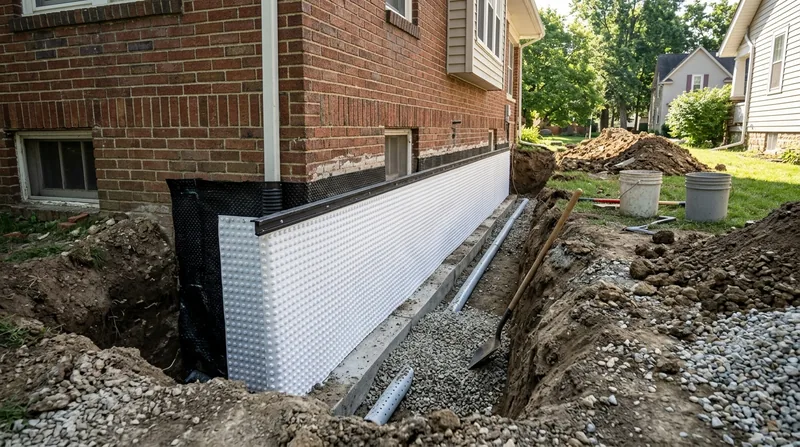




South Bend sits on a thick bed of lake-plain clay and glacial till, and that clay does one thing very well: it holds water. When the water table climbs through March and April, and again after a fast summer thunderstorm rolls across the flat northern Indiana sky, that water pushes hard against basement walls. If your 1920s bungalow in Sunnymede or your 1960s ranch in Mishawaka has a damp wall, Exterior Basement Waterproofing in South Bend is the most thorough way to stop it at the source, on the outside of the foundation, where the water actually starts. We excavate down to the footing, apply a waterproof membrane and dimple board directly to the wall, correct the grading, and extend downspouts so the water leaves the foundation alone. This is a done-once fix for walls that seep every spring, and we tell you honestly when a simpler repair will do the job instead. If you want the broader picture of how exterior work fits with other below-grade options, start with our basement waterproofing service page.
Why Exterior Waterproofing Matters on South Bend's Clay and Glacial Till
The ground under South Bend is not sandy or free-draining. It is heavy glacial clay that swells when wet and releases water slowly, which means the soil around your foundation can stay saturated for weeks after the spring melt. Hydrostatic pressure builds against the wall, finds every hairline crack, and shows up as efflorescence, a musty basement smell, or a wet corner after rain. The freeze-thaw cycles of a northern Indiana winter open those cracks a little wider each year, so a small seep in October can be a steady trickle by April.
- Water pushes through poured concrete, block, and old fieldstone walls when the surrounding clay stays saturated.
- Footing drains installed decades ago clog with silt and stop carrying water away from the wall.
- Grading that slopes back toward the house sends roof and surface water straight to the foundation.
- Short downspouts dump thousands of gallons right at the corner of the basement.
When those problems stack up, sealing the inside of the wall only hides the symptom. Stopping the water on the exterior is the fix that addresses the cause.
Key info: In the Northeast Neighborhood and East Bank, we regularly find 1900s fieldstone foundations with no original footing drain at all. The wall is sound, but the clay around it holds water like a bowl, and exterior waterproofing with a new drainage layer is the only reliable cure.
Indiana does not license home improvement contractors at the state level, so local rules and permits are handled by the city. You can verify permit requirements through the City of South Bend before any excavation begins.
How We Waterproof a South Bend Foundation From the Outside
Exterior work is excavation work, and the sequence matters as much as the materials. We start by locating utilities, then dig a trench along the wall down to the footing, usually four to six feet deep on a full basement. We clean the wall, repair any cracks we expose, apply the membrane and dimple board, and restore drainage so water has somewhere to go. On a 1950s ranch in Granger with a poured wall and a failed footing drain, this is often a two-day job; on a fieldstone foundation in Rum Village, we plan for more time because the wall surface needs parging before any membrane goes on.
- We mark utilities and confirm the excavation plan with you before the first shovel goes in.
- We dig down to the footing and expose the full height of the wall.
- We clean the wall and repair cracks and deteriorated parging.
- We apply a waterproof membrane and dimple board to protect it and create a drainage gap.
- We install or replace the footing drain and connect it to a sump basin or daylight outlet.
- We backfill with free-draining gravel, correct the grading, and extend downspouts away from the house.
Every step is done so the wall can dry and the water has a clear path away from the foundation. For a closer look at the drainage half of the job, see our French drain installation page.
Key info: A homeowner in Osceola had water at the low corner of a 1990s walkout every March. The footing drain was crushed under the backfill. We excavated the rear wall, replaced the drain, added dimple board, and regraded the slope. Two springs later, the corner is dry.
Exterior Waterproofing Methods We Use and When Each One Fits
Not every wet basement needs a full excavation, and not every crack needs the same treatment. We match the method to the wall type, the water source, and how the house was built. A 1920s brick foursquare in Francis Park with a block foundation behaves differently from a 2010 subdivision home in Granger with a poured wall and a modern footing drain.
| Approach | Description | Best for |
|---|---|---|
| Full exterior excavation | Dig to the footing, apply membrane and dimple board, replace the footing drain. | Walls that seep through spring melt and saturated clay. |
| Exterior membrane with existing drain | Waterproof the wall and tie into a footing drain that still flows. | Newer poured walls with a working drain but no membrane. |
| Crack repair plus exterior sealing | Inject or seal the crack, then protect the wall from the outside. | A single active crack with no widespread seepage. |
| Grading and downspout correction | Regrade the soil and extend downspouts to move surface water away. | Homes where roof water is the main source of the wet basement. |
| Interior perimeter drain | Interior drain tile and sump basin to manage water under the floor. | Walls where exterior excavation is not practical or cost-effective. |
We recommend the least invasive method that actually solves the problem, and we explain why when the answer is interior drainage rather than excavation.
Exterior Basement Waterproofing Cost in South Bend: What to Expect
Most exterior waterproofing in South Bend starts at From $95/linear ft, measured along the length of the wall we excavate. That figure covers excavation, wall cleaning, crack repair, membrane and dimple board, and backfill. The final number moves with depth, access, and what we find once the wall is open. A shallow foundation on a slab is one thing; a full-depth fieldstone wall with no footing drain is another.
Access is the biggest cost driver. A wall you can reach with a machine from the driveway is faster to dig than one hemmed in by a fence, a deck, or a mature tree. Wall material matters too: old fieldstone often needs parging before any membrane will bond. Depth, the condition of the existing drain, and whether we tie into a sump basin all shift the total. That is why two or three on-site estimates are worth the time, and why we put a written scope in front of you before you commit. You can see how our numbers are structured on the pricing page.
Choosing an Exterior Basement Waterproofing Contractor Near Me in South Bend
Hiring for below-grade work is different from hiring for a roof or a paint job, because most of the work is buried when it is done. Ask for proof of licensing and insurance, get two or three written estimates with the same scope so you can compare them, and call references from jobs in your part of town. A contractor who has worked on 1920s block walls in Kern Park and 1990s poured walls in Granger will talk about wall type and drainage, not just price.
Permits may be required for structural foundation repair or for work that alters drainage or the sanitary connection of a sump discharge, and the rules vary by jurisdiction. Confirm the permit path with the local building department before work starts. Ask about the warranty in writing and make sure it is transferable. When you are ready for a site visit, reach us through the contact page and we will schedule a free basement inspection.
Exterior Basement Waterproofing in South Bend: Pricing Guide
| Service | Price | Details |
|---|---|---|
| Exterior wall waterproofing | Starting at $95/linear ft | Covers excavation, wall cleaning, crack repair, membrane, dimple board, and backfill. |
| Full perimeter with new footing drain | Starting at $135/linear ft | Adds new footing drain and gravel; depth and wall material move the rate. |
| Grading and downspout correction | Starting at $1,800 | Regrades soil and extends downspouts; yard access and run length affect price. |
| Crack repair with exterior sealing | Starting at $650 | Injection or seal plus exterior protection; crack width and location determine cost. |
| Complex or large-scale job | On estimate | Fieldstone walls, tight access, or deep excavation need an on-site look first. |
| Estimate | Free | Response within 24h at (574) 800-3811, no obligation to book. |
Indicative pricing, the exact cost depends on square footage, finish, and site access. Free personalized estimate within 24h at (574) 800-3811.


