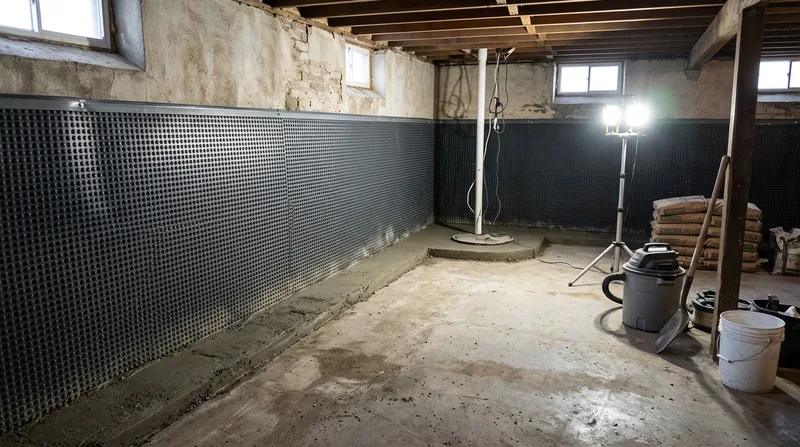




Basement Waterproofing in South Bend: Built for Lake-Plain Clay and Deep Frost
If you are searching for Basement Waterproofing in South Bend, you already know the pattern: water shows up in the low corner after a March thaw, the floor joint stains dark after a summer downpour, and the musty smell never quite leaves. South Bend sits on lake-plain clay and glacial till that drains slowly, so the water table climbs every spring and pushes against basement walls from the outside. The housing stock makes it worse: 1900s brick bungalows in Sunnymede and Kern Park with fieldstone or block walls, Studebaker-era cottages in Rum Village with partly finished basements, and 1990s-plus poured basements in Granger and Osceola. We trace the actual water path, then build the system that fits the house instead of selling you a one-size-fits-all fix. Start with a free basement inspection and we will tell you plainly what is happening below grade.
Why Wet Basements Are the Norm in South Bend, Not the Exception
South Bend gets a freeze-thaw cycle that opens hairline cracks in poured walls every winter, then sends snowmelt and spring rain into ground that is already saturated. The St. Joseph River flood stages and fast summer thunderstorm runoff push water toward low corners and footing drains that were never sized for today's rainfall. In the older neighborhoods, the original weeping tile is often clay or collapsed, so water has nowhere to go but through the wall.
- Hydrostatic pressure builds under glacial clay soil and forces water through cove joints and floor cracks.
- Freeze-thaw cycles widen existing wall cracks a little more each winter.
- Original footing drains in pre-war homes clog or collapse and stop moving water away.
- Downspouts that discharge too close to the foundation reload the same soil that is already saturated.
None of these are cosmetic problems, and none of them fix themselves when the rain stops.
Key info: A 1920s brick foursquare in the Northeast Neighborhood with efflorescence on the lower block wall is telling you water is moving through the masonry, not just sitting on it. That is a drainage problem first, a wall-sealing problem second.
For the local code and permit side of structural or drainage work, verify current requirements with the City of South Bend building department before work begins.
How We Waterproof a South Bend Basement, Step by Step
We start by finding where the water actually enters, not where the stain is. That means checking the wall base, the floor joint, window wells, and the exterior grade, and asking how the basement behaves during the March and April water table climb versus a July thunderstorm. Then we choose between interior drainage, exterior excavation, crack injection, or a combination, and we explain why.
- We inspect the basement, foundation walls, and exterior grade, and identify the water path.
- We recommend the least invasive system that solves the actual problem, interior drain tile or exterior membrane.
- We cut and install an interior perimeter drain into a new sump basin with a check valve and discharge line.
- We seal wall cracks by epoxy or polyurethane injection where injection is the right answer.
- We install a vapor barrier and dimple board where wall moisture needs managing.
- We test the sump pump and walk you through discharge routing and battery backup options.
Every job ends with a wet test and a plain-language explanation of what to watch for next spring.
Key info: A 1960s ranch in Mishawaka with water only at the floor joint after heavy rain usually needs an interior drain tile system, not a full exterior dig. We will say so even when the exterior job would bill higher.
Waterproofing Approaches We Use in South Bend Homes
The right approach depends on the wall material, the water source, and how the basement is used. A fieldstone wall in Kern Park behaves differently from a poured wall in a Granger subdivision, and a finished basement raises the stakes on every decision. Here is how the main methods compare.
| Approach | Description | Best for |
|---|---|---|
| Interior drain tile | Perimeter drain cut into the floor slab and routed to a sump basin | Hydrostatic pressure and floor joint seepage |
| Exterior waterproofing | Excavation, membrane, dimple board, and new footing drain | Failed exterior coating and bowing walls |
| Crack injection | Epoxy or polyurethane injected through ports into the crack | Isolated vertical wall cracks |
| Wall sealing and vapor barrier | Parging repair, sealer, and interior vapor barrier | Damp walls and musty basement smell |
| Sump pump and battery backup | Primary pump, check valve, discharge line, backup power | Any drained system that cannot fail during a storm |
We combine these methods when the house calls for it, and we tell you when simple crack sealing is enough.
Basement Waterproofing Cost in South Bend: What to Expect
Most full basement waterproofing projects in South Bend start around From $2,500 and climb from there based on scope. A single crack injection is a much smaller job than a full interior perimeter drain with a new sump basin, and an exterior excavation with membrane and new footing drain is larger still. The variables that move the number are the length of wall involved, wall material (fieldstone costs more to work than poured concrete), whether the basement is finished, sump pump and battery backup add-ons, and access for equipment.
We give you a written scope, not a ballpark, because a quote without a stated water source is a guess. Getting two or three estimates is smart in this trade, and any contractor who will not explain why they chose interior versus exterior is telling you something. Our full pricing overview breaks down the ranges by system type.
Finding a Basement Waterproofing Contractor Near Me in South Bend
Hiring near South Bend means hiring someone who knows lake-plain clay, not someone who learned the trade in sandy soil. Ask for proof of licensing and insurance, get at least two written estimates with the water source named, and call references from jobs at least one full spring old. Ask whether permits are required for your scope, since structural foundation repair and work that alters drainage or the sump discharge connection can trigger them, and rules vary by jurisdiction. If you are in an HOA, confirm exterior excavation and discharge routing requirements before signing.
Reach out through our contact page to schedule a walkthrough.
Basement Waterproofing in South Bend: Pricing Guide
| Service | Price | Details |
|---|---|---|
| Crack injection (epoxy or polyurethane) | Starting at $2,500 | Includes port installation, injection, and sealing of isolated vertical cracks, with price rising by crack length and wall access |
| Interior drain tile and sump system | Starting at $4,500 | Includes perimeter drain, sump basin, pump, and discharge line, with finished basements and long runs raising the figure |
| Exterior waterproofing with membrane | On estimate | Excavation, membrane, dimple board, and footing drain require an on-site look at depth, access, and wall condition |
| Sump pump replacement with battery backup | Starting at $950 | Includes pump, check valve, discharge routing, and backup unit, with discharge distance and pit condition affecting price |
| Travel | Included | in South Bend and surrounding areas, no separate call-out or mileage fee |
| Estimate | Free | Response within 24h at (574) 800-3811, no obligation to book |
Indicative pricing, the exact cost depends on square footage, finish, and site access. Free personalized estimate within 24h at (574) 800-3811.


